Ablative Material Testing Fixture

Ablative Material Testing Fixture

This project focused on the design, iteration, and validation of a laboratory-scale ablative material testing setup for the UIUC Liquid Rocket Initiative (LRI). The goal was to enable repeatable, controlled heat-flux testing of candidate ablative materials while minimizing parasitic heat losses and measurement artifacts.

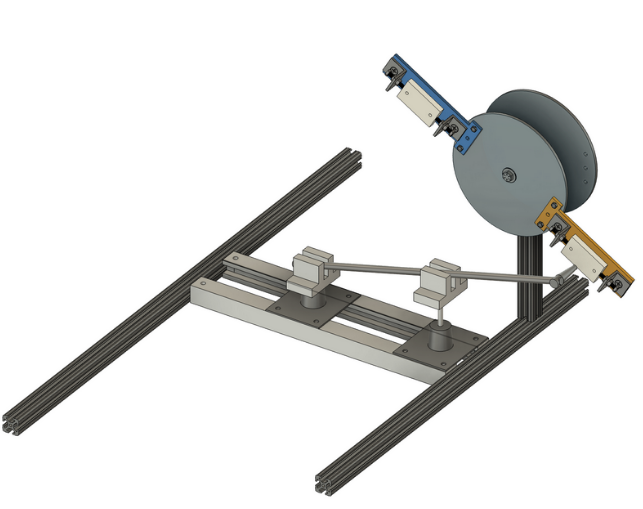
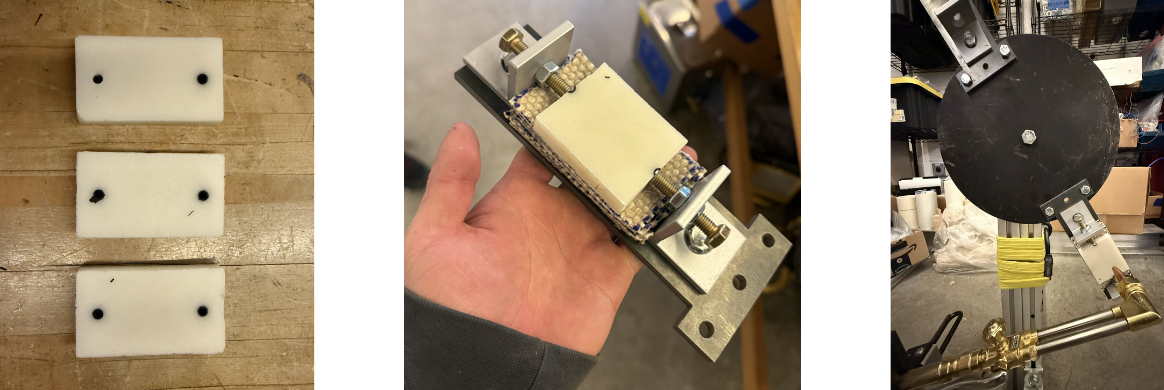
The final system integrates a fixed torch with a steel sliding-rail mechanism that allows rapid switching between a graphite reference sample and ablative specimens. Emphasis was placed on thermocouple placement, fixture rigidity, heat isolation, and experimental repeatability, informed through multiple design reviews and test iterations.

Documentation
View documentation
Group
UIUC Liquid Rocket Initiative (LRI)
Role
Mechanical Design & Experimental Systems Engineer
Skills
Thermal Testing, Experimental Design, Heat Transfer, CAD (Fusion 360), Instrumentation, Thermocouples, Ablative Materials, Design for Safety
Year
2026

Initial Design

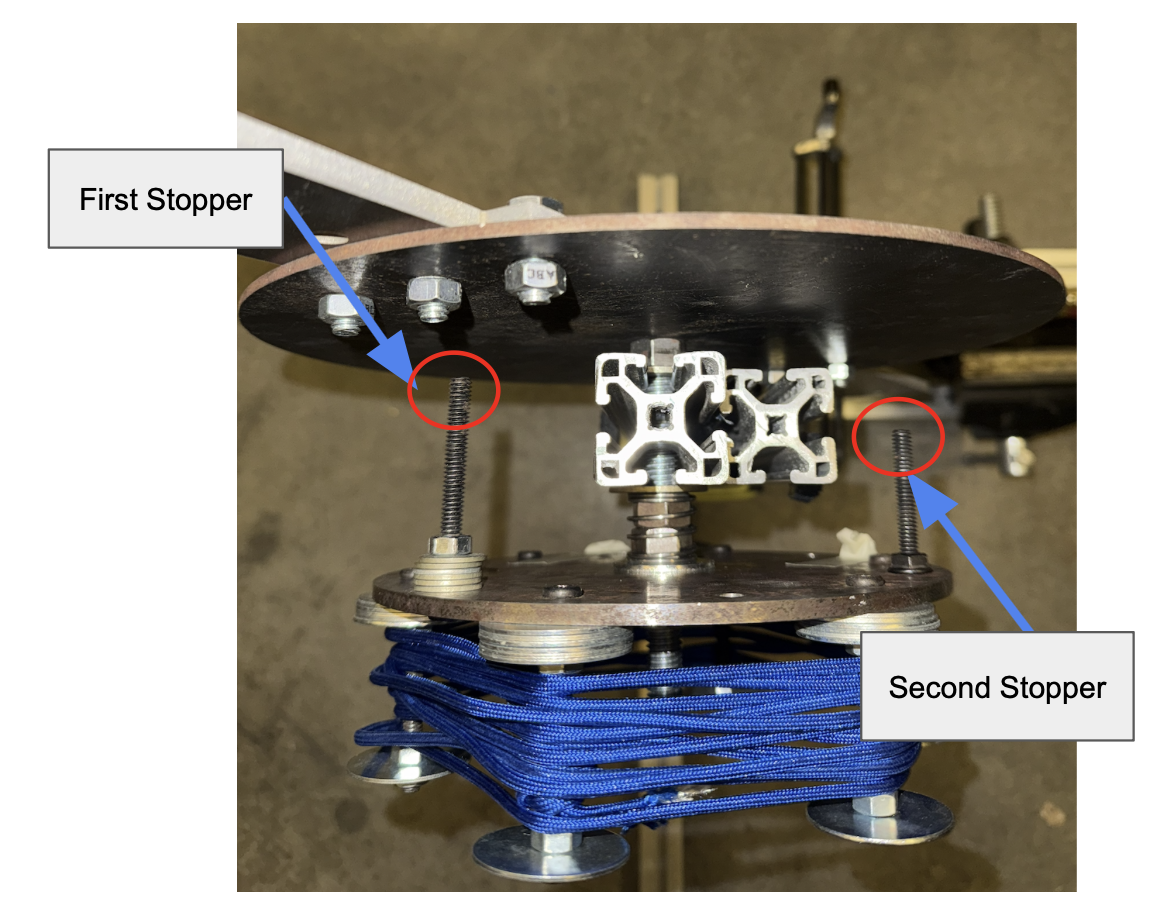
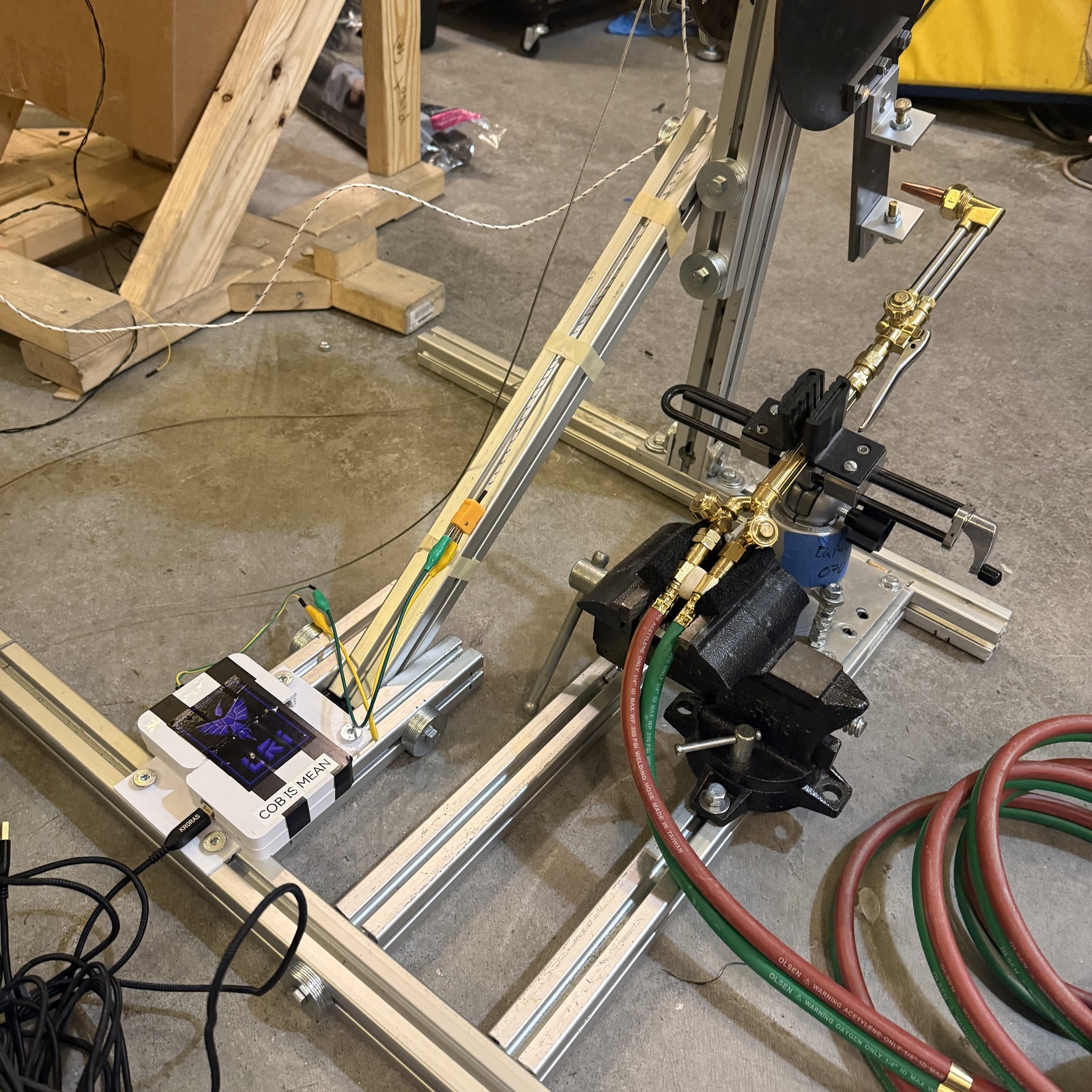
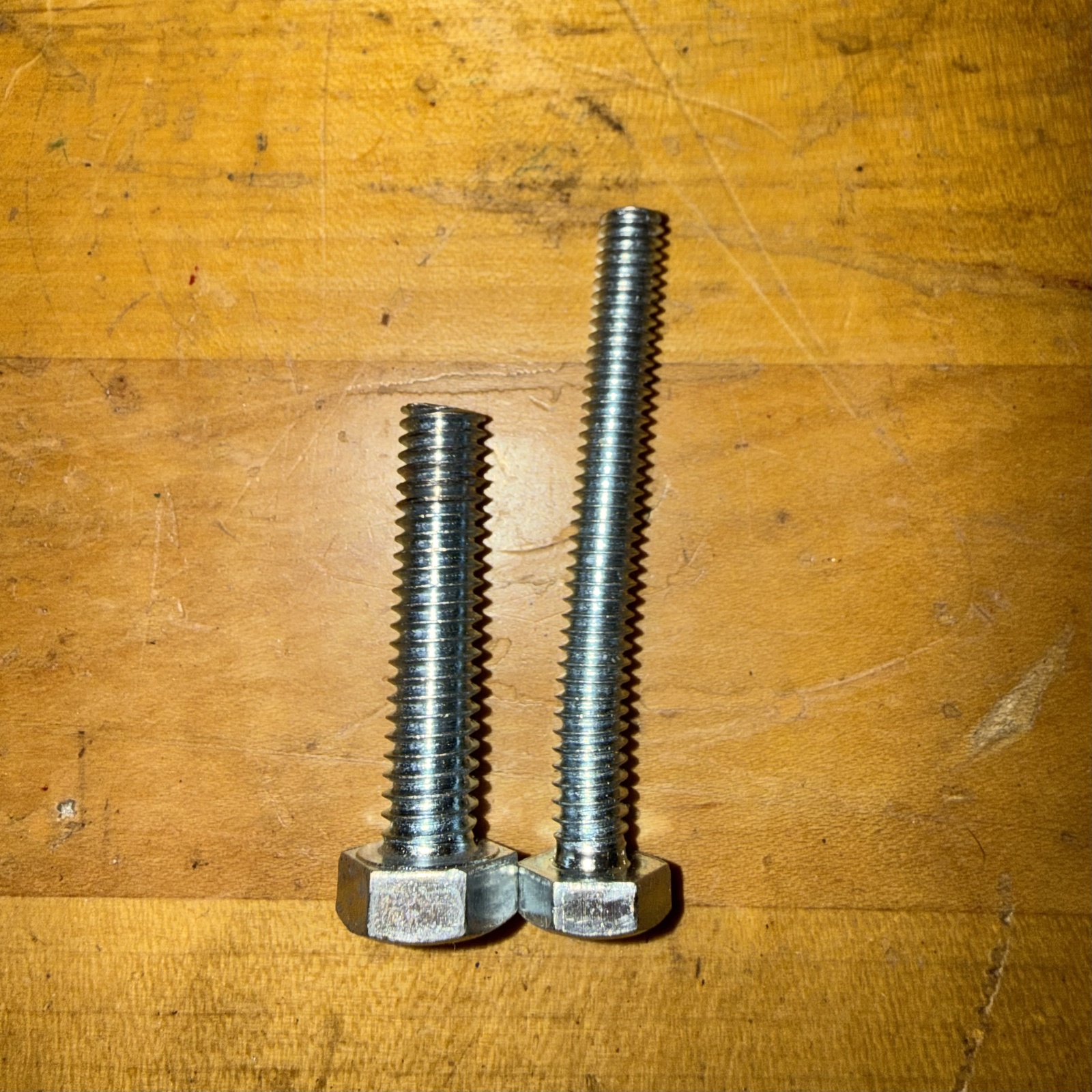
Our first prototype used a bungee cord return and two indexing pins to define discrete stop positions. While the bungee enabled automatic rotation, we observed the stop bolts plastically deforming after only a handful of cycles, indicating impact-dominated loading at the hard stops. The layout also created a safety hazard: the operator could be positioned downstream of the torch plume during indexing if not sufficiently offset. In addition, the improvised “pins” (screwdrivers) did not seat repeatably in the gear holes, leading to inconsistent indexing angles and poor test-to-test repeatability. These issues motivated a redesigned indexing mechanism that (i) bounded impact loads, (ii) increased operator stand-off from the flame, and (iii) enforced repeatable, well-defined stop geometry.

Rotating Gear Design

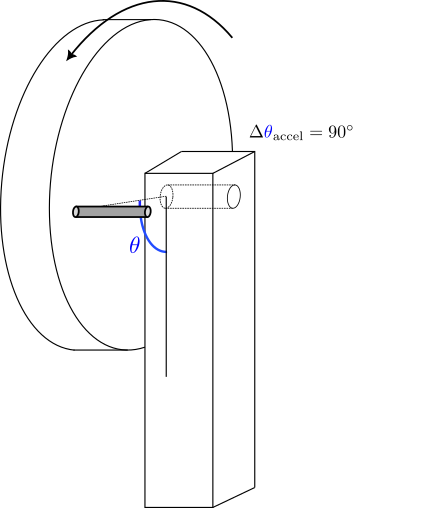
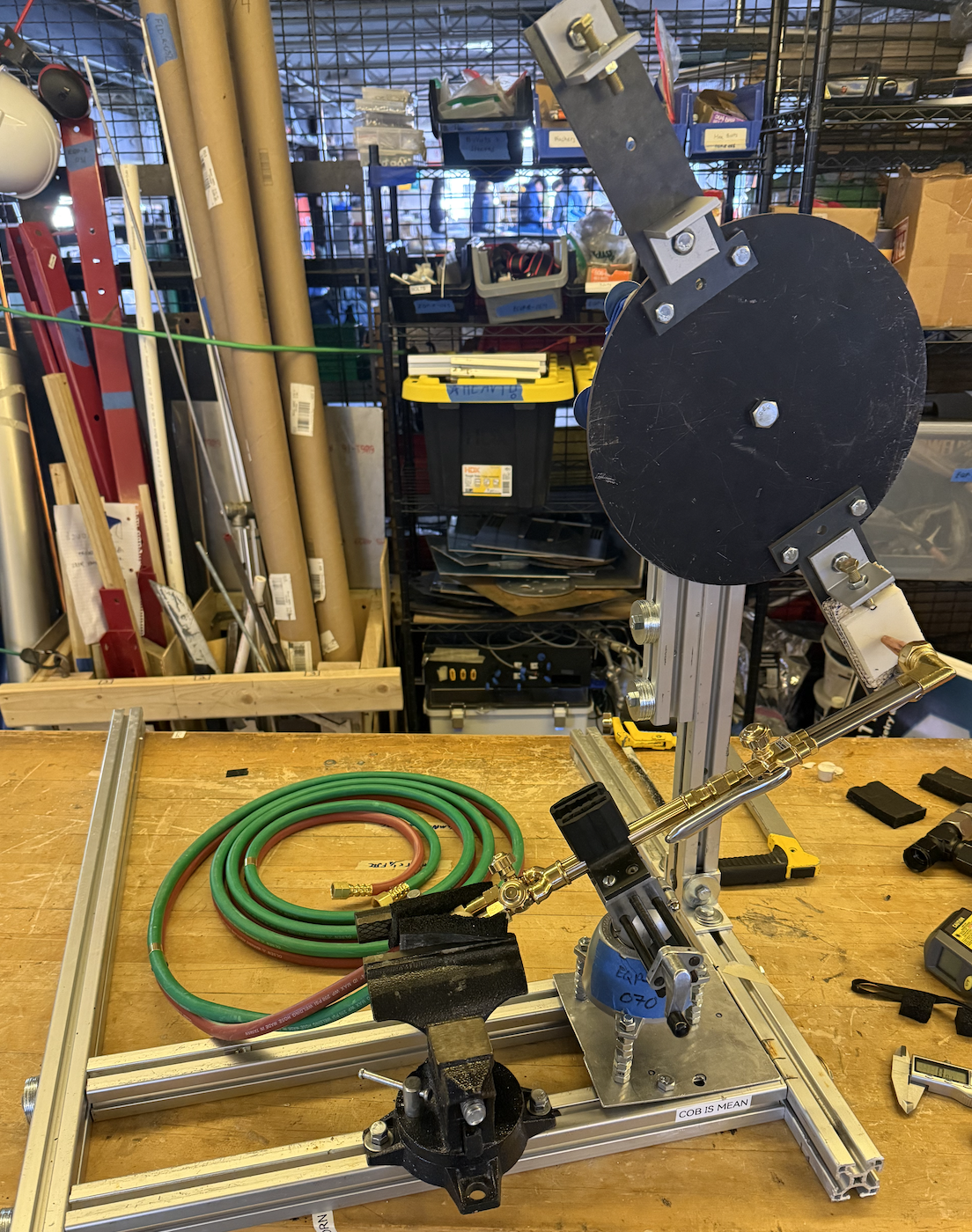
For the ablative test rig, I designed a mechanically constrained rotating disk system for rapid, repeatable sample exchange under flame exposure. Precision alignment bolts fix each specimen relative to the torch, while T-slot walls act as hard 180° stops to prevent over-rotation. Opposing cables enable remote indexing, maintaining operator distance from ~3000 K conditions and ensuring controlled, repeatable positioning for comparative ablation testing.

During early testing, cable-induced torque plastically deformed the clamping bolts. Even at reduced speeds, repeated cycling caused cumulative yielding, confirming that peak torque—not angular velocity—governed failure. This deformation degraded angular fidelity between ablative and graphite samples, directly compromising repeatability and thermal alignment.

Simplified Model

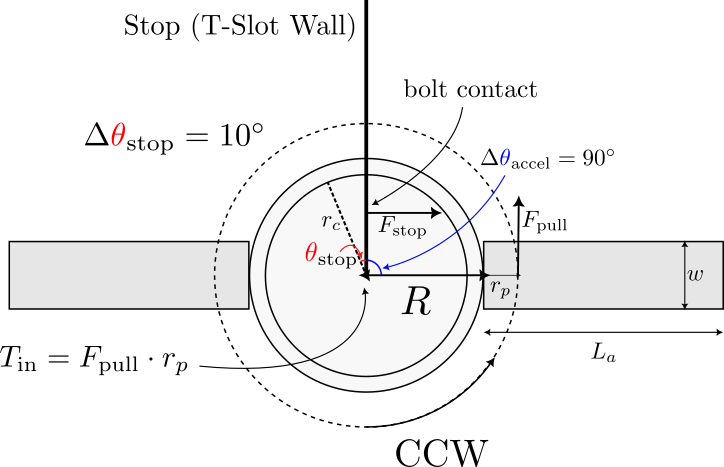
To address this, I developed a simplified mechanical model of the disk--bolt--cable system to quantify the relationship between applied cable force, disk radius, and resulting bolt stresses. By treating the disk as a rigid body with reaction forces localized at the bolt interfaces and enforcing equilibrium under applied torque, I derived allowable force limits based on bolt material yield strength and cross-sectional properties. This analysis produced a safe operating force range for manual actuation, eliminating plastic deformation while preserving reliable indexing. The result was a mechanically bounded system with defined load constraints, transforming an empirical failure into a controlled, analytically governed design parameter.

Impact (slam) speed limit
Assume one bolt takes the full stop load (worst-case). If the disk impacts the stop at angular speed \(\omega\) (rad/s), the rotational kinetic energy is
\[ E_k=\frac{1}{2}\frac{I}{g_c}\,\omega^2, \]
where \(I\) is the mass moment of inertia in \(\mathrm{lbm\cdot in^2}\) and \(g_c=386.09~\mathrm{\frac{lbm\cdot in}{lbf\cdot s^2}}\).

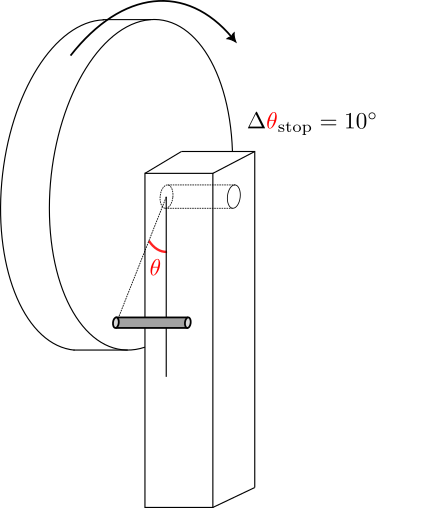
Assuming the stop dissipates this energy over the compliance angle \(\Delta\theta_{\text{stop}}\), and using a linear torque ramp \((T_{\text{peak}}\approx 2T_{\text{avg}})\),
\[ T_{\text{stop,peak}}\approx \frac{2E_k}{\Delta\theta_{\text{stop}}}. \]
Convert peak stop torque to bolt bending stress (threads in bending):
\[ \sigma_{\text{bolt,peak}} = \frac{32}{\pi d_{\text{minor}}^3} \left(\frac{T_{\text{stop,peak}}}{r_c}\right) L_{\text{bolt,eff}}. \]
Combining all terms gives a speed--stress relationship:
\[ \sigma_{\text{bolt,peak}} = \left( \frac{ 32 I L_{\text{bolt,eff}} }{ \pi d_{\text{minor}}^3 \Delta\theta_{\text{stop}} r_c g_c } \right)\omega^2. \]

Numerical evaluation
Using
\(I = 351.352~\mathrm{lbm\cdot in^2}\),
\(g_c = 386.09~\mathrm{\frac{lbm\cdot in}{lbf\cdot s^2}}\),
\(\Delta\theta_{\text{stop}}=\pi/18\),
\(r_c=3.75~\mathrm{in}\),
\(L_{\text{bolt,eff}}=2.75~\mathrm{in}\),
\(d_{\text{minor}}=0.19~\mathrm{in}\),
the stress law reduces to
\[ \sigma_{\text{bolt,peak}} \approx 5678\,\omega^2~\mathrm{psi} = 5.678\,\omega^2~\mathrm{ksi}, \qquad (\omega \text{ in rad/s}). \]

Grade 2 ''no-yield'' speed
Assume Grade 2 yield strength \(S_y \approx 57~\mathrm{ksi}\). If ``do not yield'' means \(\sigma_{\text{allow}}=57~\mathrm{ksi}\),
\[ 57 = 5.678\,\omega^2 \quad\Rightarrow\quad \omega_{\max}=3.17~\mathrm{rad/s}. \]
Convert to RPM:
\[ N_{\max} = \omega_{\max}\frac{60}{2\pi} = 30.3~\mathrm{rpm}. \]
\[ \boxed{N_{\max}\approx 30~\text{rpm at the moment of impact}.} \]

Recommended engineering limits (with safety factor)
If instead \(\sigma_{\text{allow}}=\frac{S_y}{n_y}\), then:
- For \(n_y=2\): \(N_{\max}\approx 21.4~\mathrm{rpm}\).
- For \(n_y=3\): \(N_{\max}\approx 17.5~\mathrm{rpm}\).

A conservative operating recommendation is therefore:
\[ \boxed{\text{Keep impact speed } \lesssim 17\text{--}20~\mathrm{rpm}.} \]
\[ \boxed{20~\mathrm{rpm} \approx 0.333~\mathrm{rev/s}.} \]

At \(20~\mathrm{rpm}\) (\(0.333~\mathrm{rev/s}\)), the disk rotates at about \(120^\circ/\mathrm{s}\). That means a \(90^\circ\) index move takes roughly \(t \approx 0.75~\mathrm{s}\) if you rotate at a steady rate. Practically, this is a “moderate” motion—fast enough that you should consciously slow down as you approach the hard stop, since bolt yielding is driven by the impact speed at contact (i.e., \(\omega\) right before the stop), not the average speed over the full rotation.
Process

Initial testing revealed several key challenges, including unstable torch mounting, parasitic heat sinking through fixtures, and thermal cross-talk between successive specimens. Early setups relied on single-point torch mounting and aluminum T-slot rails, both of which proved unsuitable under sustained high heat flux.

Following advisor feedback, the design evolved toward a rigid, multi-point torch mount and a steel sliding-rail system. This allowed controlled translation between a graphite reference sample and test specimens without disturbing torch alignment. Additional measures included silica cloth insulation, embedded thermocouples, and elimination of unintended heat sinks in the measurement chain.

Multiple design reviews guided refinements in torch orientation, thermocouple geometry, fixture materials, and test procedure sequencing.

Outcome

The final fixture enabled consistent, repeatable ablative testing under controlled torch heating conditions. The sliding-rail system allowed rapid transitions between reference and test samples while maintaining identical thermal boundary conditions. Improved thermocouple placement and fixture isolation significantly reduced measurement error caused by heat sinking.

This work established a reliable experimental baseline for future ablative material characterization within LRI and informed subsequent heat-flux estimation using analytical models such as the Bartz equation. The system is now suitable for comparative testing of candidate materials under rocket-relevant thermal loads.

Demonstration