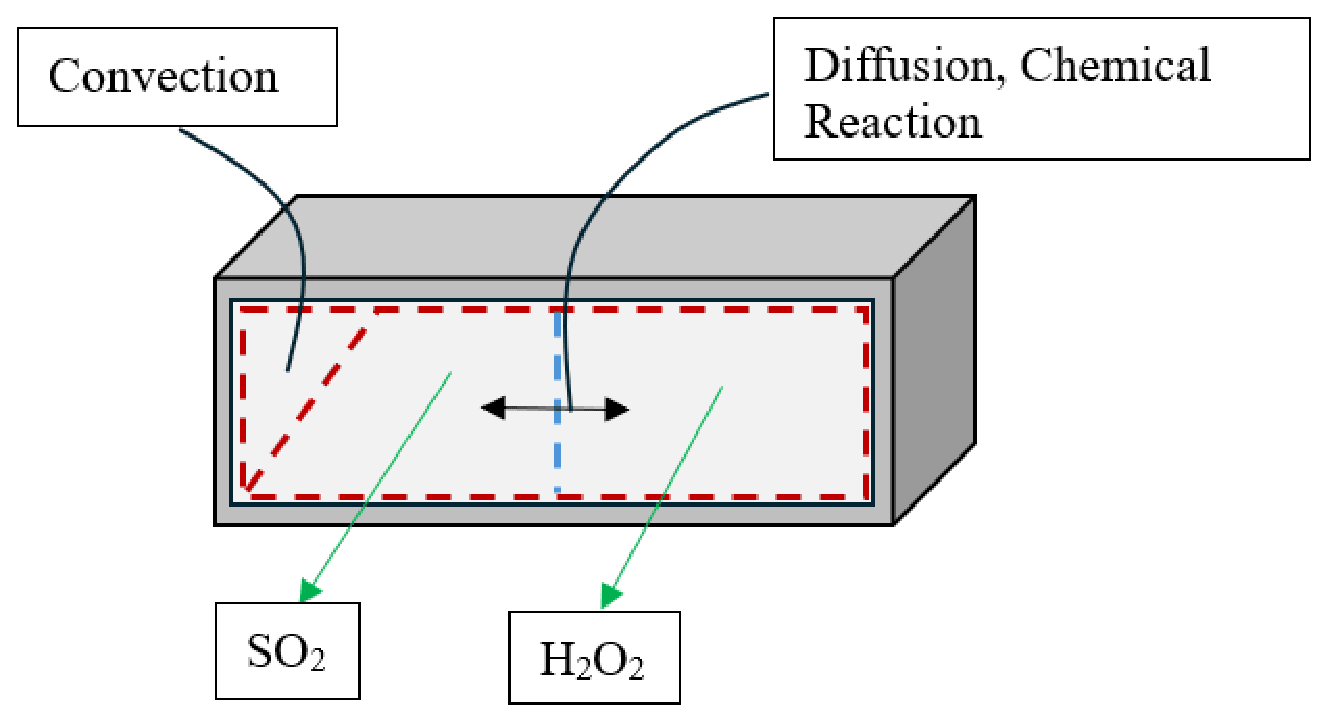
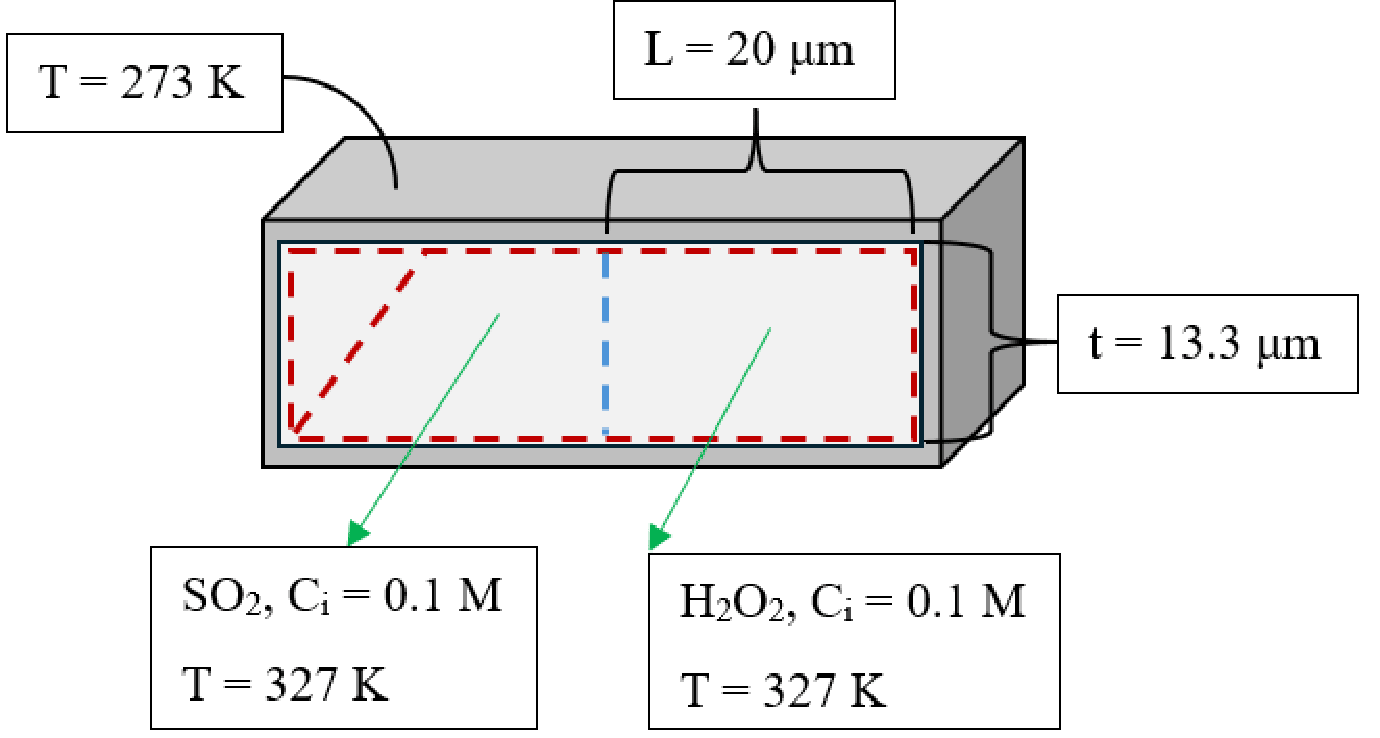
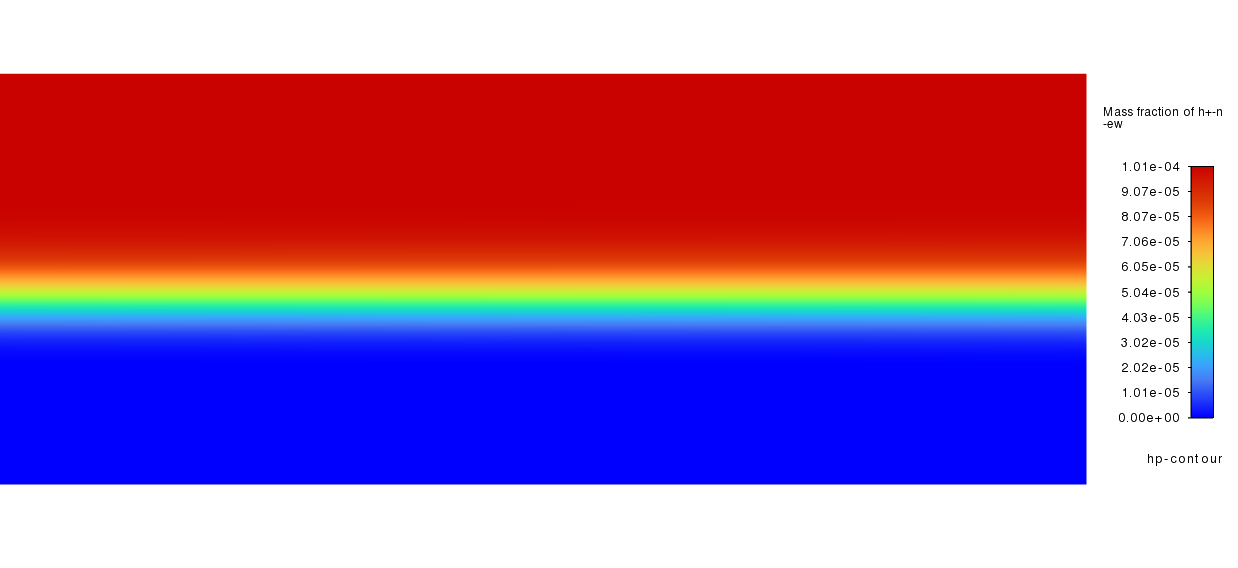
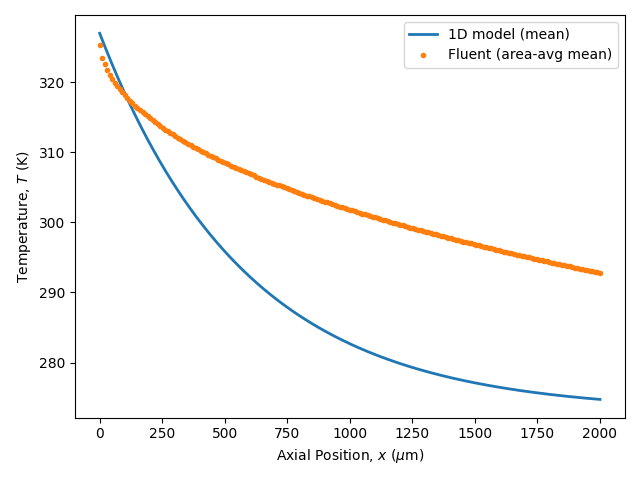
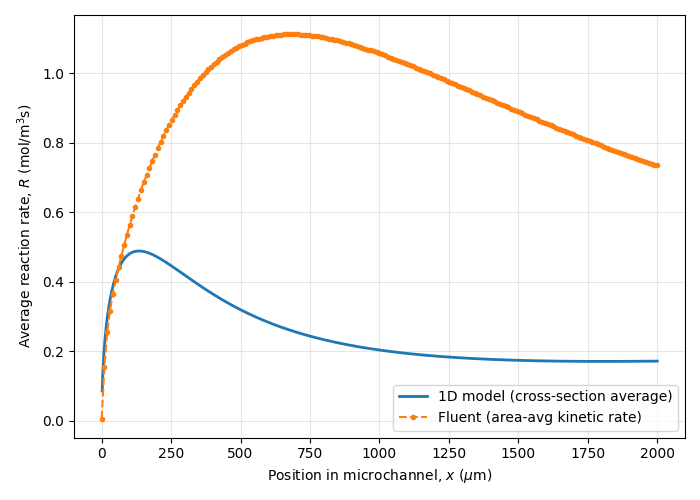
To quantify coupled transport and reaction behavior in the microchannel, I developed a reduced-order model of the convection–diffusion–reaction system governing sulfuric acid formation from aqueous sulfur dioxide and hydrogen peroxide. The balanced reaction is
\[
\mathrm{SO_2 + H_2O_2 \rightarrow H_2SO_4}.
\]
The objective was to predict axial temperature evolution, species concentration profiles, and reaction rate behavior while avoiding the computational expense of a fully coupled 2D CFD simulation.
Starting from conservation of momentum, energy, and species for steady, incompressible, laminar flow, and neglecting body forces, viscous dissipation, and transverse velocity, the governing equations reduce to
\[
\frac{\partial p}{\partial x} = \mu \frac{\partial^2 u}{\partial y^2},
\]
\[
\rho c_p u \frac{\partial T}{\partial x}
= k \frac{\partial^2 T}{\partial y^2} + \dot{q},
\]
\[
u \frac{\partial C_i}{\partial x}
= D_{AB} \frac{\partial^2 C_i}{\partial y^2} + \dot{N}_i.
\]
The reaction source term follows a bimolecular Arrhenius rate law,
\[
R = k C_1 C_2,
\qquad
k = A e^{-E_a/(k_b T)},
\]
giving
\[
\dot{N}_i = A e^{-E_a/(k_b T)} C_1 C_2,
\qquad
\dot{q} = \Delta H \, A e^{-E_a/(k_b T)} C_1 C_2.
\]
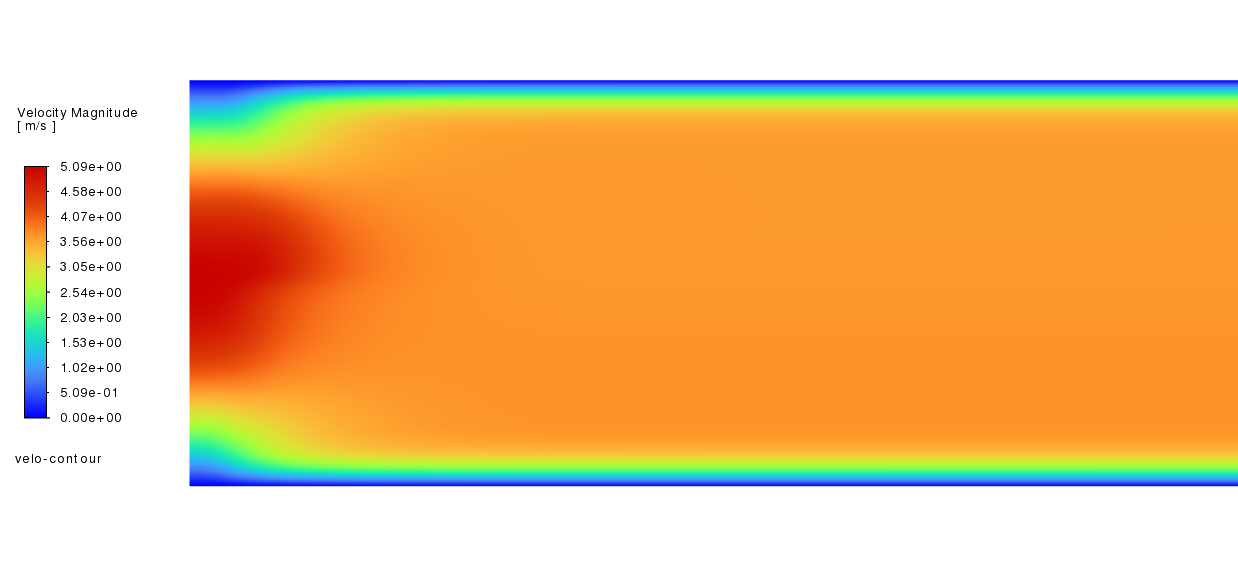
To reduce the system order, I assumed constant fluid properties (evaluated at 300 K), negligible entrance effects, and fully developed laminar flow. Under these conditions, the velocity profile decouples and admits the analytical solution
\[
u(y) = \frac{3}{2} u_m \left(1 - \left(\frac{y}{L}\right)^2 \right).
\]
The mean velocity is determined from the laminar duct relation
\[
\frac{\Delta p}{\Delta x}
= f \frac{\rho u_m^2}{2 D_h},
\qquad
f Re = 69,
\]
yielding
\[
u_m = 3.39~\mathrm{m/s},
\qquad
Re = 79,
\]
confirming deeply laminar flow. The corresponding Nusselt number is \(Nu = 3.96\), giving a convection coefficient
\[
h = 1.21 \times 10^5~\mathrm{W/m^2K},
\]
consistent with microscale heat transfer.
Rather than solving the full 2D energy PDE, I applied a cross-sectionally averaged energy balance to derive a nonlinear first-order ODE for the mean fluid temperature:
\[
\frac{dT_m}{dx}
=
\frac{P h}{\dot{m} c_p} (T_s - T_m)
+
\frac{A_c \Delta H}{\dot{m} c_p}
\left(
A e^{-E_a/(k T_m)} C_1 C_2
\right).
\]
This equation captures the competition between convective wall cooling and exothermic reaction heating. The reduction from a 2D PDE to a 1D nonlinear ODE preserves the dominant axial physics while eliminating transverse temperature resolution.
The species equation retains its convection–diffusion structure but is solved using the analytical velocity profile:
\[
u(y) \frac{\partial C_i}{\partial x}
=
D_{AB} \frac{\partial^2 C_i}{\partial y^2}
+
A e^{-E_a/(k T_m)} C_1 C_2.
\]
The final reduced-order system therefore consists of:
- An analytical laminar velocity field,
- A 1D nonlinear temperature ODE,
- A convection–diffusion–reaction species equation.
The temperature ODE is integrated using explicit fourth-order Runge–Kutta, while the species equation is discretized via finite differences with a semi-implicit scheme to maintain stability under strong reaction coupling.
This reduced-order framework transforms a fully coupled multiphysics PDE system into a computationally efficient, physically interpretable model. It enables rapid parametric exploration of reaction kinetics, wall temperature effects, and inlet concentration ratios—providing predictive insight into microchannel transport behavior while retaining the dominant thermal and chemical physics governing sulfuric acid formation.