Demons Round 1
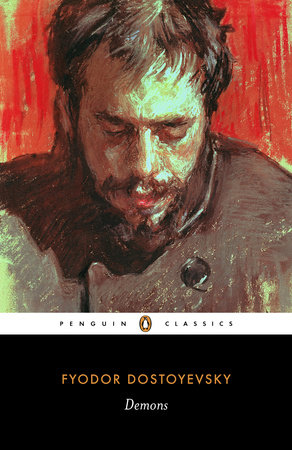
I finished Demons by Dostoevsky this past Monday, August 24th, after starting the book on May 24th. Wow that’s exactly three months haha. I’ve been meaning to write more essays about the books that I finish so here’s another attempt. First off, reading 19th century Russian literature is kind of annoying and takes a ton of getting used to. My brain does a ton of the work filtering thru the literal translations and it is hard to reach ideas originally if you read too fast. Second, by the addition of this read, I have achieved the Western Dostoevsky “Big 5” (Notes from Underground, Crime & Punishment, The Idiot, The Brother’s Karamazov, Demons). Woohoo!
I first want to write about the definition of a demon. The word “Demon” was a word closer to the Greek daimōn: an unseen, superhuman intelligence or operator—not necessarily an evil Christian demon. Such a being is granted one extraordinary privilege and used to stress-test a theory; like taking the limit as n → ∞.
For example, in physics, there exist Laplace’s Demon and Maxwell’s Demon. Laplace thought about what could happen if you took classical determinism to the very limit—what happens if you had a superintelligent entity that could determine the entire future if had enough information in the now?
Maxwell thought about what happens if you took Clausius’ Law of dS ≥ 0 to the limit, where S is system entropy, and add a strange twist; if the number of available microstates of a system is a monotonic function (either increasing or staying the same), what if an external superintelligence could “shrink” the number of total states down, directly violating dS ≥ 0?
Dostoevsky thought about what happens when you take an abstract idea or a collection of ideas, and directly apply them to a society to its very limit. He called his demons “forces” that drive the action of individuals that eventually take over or “possess” a society. So analogously, Dostoevsky’s Demon asks the question, “what happens when a set of ideas takes over the consciousness of a society?”
In Russian culture there is this notion of a “Russian soul” aka русская душа, and it has its own axioms that make it that Russian soul. In Dostoevsky’s Demons, the author explores what could happen when external forces (demons, i.e. new radical ideas, self interest) tilt this soul plastically and extrapolates it to the limit.
In Hofstadter’s GEB, there’s an excerpt that describes a conscious ant colony named “Aunt Hillary” and is able to interact with the main characters of the story but they have no idea that she is an ant colony. One day a rainstorm rearranges the ants in the colony and the characters of the book are confused because Aunt Hillary is no longer herself anymore.
The main takeaway from the novel was to be aware of ideas that involve the materialization of people to achieve the idea’s goals. Dostoevsky showcased this in several forms throughout the book through the main characters. He illustrated the paradoxical nature of “using individual people as material” to “help society as a whole”, i.e., treating people as capital with the goal of improving humanity.
Another takeaway from the book (and the accumulated residuals from his 4 other books) is that each human, irrespective of status, social hierarchy, background, nationally, ethnicity, have lives that have immeasurable worth as a basis. There should be no reason to use a certain person or a group of people as material to go from A → B for the benefit of another group or individual. Each person needs love, is intrinsically 1-of-1, and has limits (boundaries). To be able to continually be conscious and aware of these for each person I come across in my own life is something that I want to practice everyday. To use the excuse “I do it for humanity as a whole” as a justification for the undermining of an individual is not acceptable in my book.
As a plot, Demons was my favorite out of the Big 5. The first ~200 pages took me about 2 months to complete due to the dense and complex orchestra of major players, but once each person is introduced and understood, the rest of the novel (~400 pages) is a rollercoaster thriller. I can’t wait to read this again someday.